TOMRA Collection Solutions on Global Recycling Day

Helen Evans • March 28, 2019

Did you know that Monday 18 March is Global Recycling Day? What better time to catch up with our partners over at TOMRA Collection Solutions to find out more about recycling in Australia. Helen Evans speaks to TOMRA’s Marketing Director, Martin Walters.


Tell us about TOMRA and what you do within the organisation?


Working in the beverage container recycling sector, TOMRA is the network operator for the Return and Earn container deposit scheme in New South Wales, which is where we started. We now have 10 modern recycling depots in Queensland too. As Marketing Director for TOMRA Australia, I cover both NSW and since last November, QLD as well. These are the 2 main markets in which we operate, covering 2 different government schemes; the Return and Earn scheme in NSW and Containers for Change in QLD.


In NSW we have over 320 ‘RVM kiosks’. RVM stands for Reverse Vending Machines, which is essentially what these machines are because you put your container in, and get money out, which is the opposite of a typical vending machine! They’re in places like Woolworths, Coles and IGA car parks, as well as at bowling clubs, golf clubs and other sporting clubs all over NSW. Plus, last month we also launched NSW's most advanced container recycling centre right here in Sydney - at 4 Paramatta Road, Granville.


In QLD the scheme is quite different. There we have 10 large modern depots, each with 9 RVM's, plus an express bag drop service and commercial bulk sorting. My role is to work across both these schemes, make sure people are having a good customer experience and ensure they feel the scheme is rewarding and working well for them. We’re also responsible for the communication all of the necessary user information on the RVM's. Beyond the financial benefits for the consumer, my role is to work out how to communicate the environmental benefits of both the schemes; how we’re improving and reducing litter, improving the overall beverage recycling rate, and how we’re starting to build an emotional connection between people and the schemes - rather than just a transactional one. We want people to know and feel they’re making a difference, and to emotionally connect with the purpose of the scheme, rather than just the financial reward.
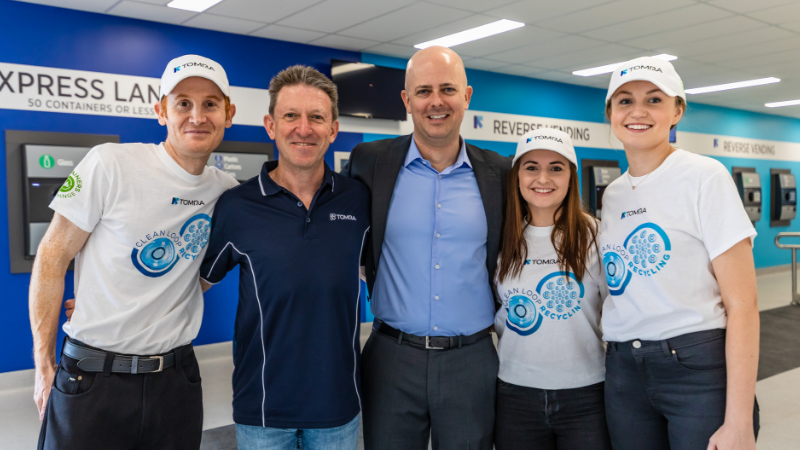
We also have an objective here, and globally, to make TOMRA a household name, and to communicate what the TOMRA brand stands for. We’re a very purpose-driven organisation. We describe ourselves as a ‘for-profit company that does good things’, and we’re very purpose driven right from the top down; the Worldwide CEO Stefan Ranstrand is committed to helping the environment and reducing the inefficient use of resources. The whole idea of the circular economy is essential to TOMRA’s ‘why?’.


On Friday we’ll be launching the concept of ‘Clean Loop Recycling’ in Australia. This is TOMRA's language for the circular economy in respect to beverage recycling. In simple terms, this means we turn bottles back into bottles and cans back into cans. We’re committed to this concept because we can’t keep utilising our resources the way we currently are. Globally, only 2% of all beverage containers are currently recycled.


Thanks to the Return and Earn scheme and TOMRA's RVM's in NSW, we now recycle almost 60% of all beverage containers here - up from about 35% prior to the scheme commencing in December 2017.


What can we expect to see from TOMRA for Global Recycling Day?


TOMRA has two brand ambassadors: Tim Silverwood, Founder of Take 3 for the Sea, and Laura Wells, Environmentalist, Marine Biologist and Plus-Size Model. Laura has been recording lots of content pieces with us this week which you’ll see pushed out over social media next week. These cover lots of recycling tips, such as helping to clarify which containers can be returned through the scheme and which can’t. Other tips from Laura include making sure you take your lids off (they’re made of a different plastic, so they contaminate the recycling process) and remove straws. You can put these inside a larger plastic container and then put them out for kerbside recycling. 


We are also launching a new 5-minute film as part of our series of films called ‘TOMRA Presents’. This series covers inspirational stories of people who are out there, doing their bit to make a difference; being part of the solution, not part of the problem. Our new film is about the Seabin project - a uniquely Australian invention from a couple of surfers which has now gone global. The concept is that we have rubbish bins on land, so why not in the water too?


Australia's first official Seabin has just been installed in Darling Harbour and was sponsored exclusively by TOMRA. It uses super-cool technology to suck rubbish off the surface - bottles, wrappers, plastic bags, rubbish etc. which are then removed from the water. We are now working on how to recycle the material we capture. The film will be launched on Friday 15 March on our website and across a range of social media channels including myTOMRA AustraliaTake 3 for the Sea and The Seabin Project.


What’s one small thing we can all do to make a difference?


Firstly, you can start by saving up your eligible beverage containers to put in a Return and Earn reverse vending machine near you, rather than putting them in your yellow kerbside bin at home. Secondly, you can definitely Take 3 for the Sea. This is a simple concept: when you go to the beach or the park, take 3 things away with you which you didn't take there. There’s a good chance one of these may be a beverage container, so you can keep a bag in the back of your car and drop them at a return and earn kiosk when you pass one. You can donate the 10 cents you earn if you don’t need it yourself.


For more information, head to mytomra.com.au or follow TOMRA on Facebook for regular updates.

You can also download free MyTOMRA app to find out more about recycling machines available.

By Brianna P June 24, 2026
As EOFY approaches and budgets come under the microscope, the conversation in Australian agencies and marketing boardrooms are changing. For many, the challenge is no longer simply digital transformation or AI adoption. The focus has shifted to building marketing teams that can drive commercial growth in a more complex and increasingly AI-enabled market. At iknowho , our conversations with senior marketing talent, CMOs, and business leaders across Australia point to a clear shift in both employer expectations and candidate priorities. The marketers in demand in today’s market are commercially fluent, strategically agile, and able to apply technology in ways that genuinely impact business performance. As specialist recruiters with deep marketing industry experience, we are seeing the organisations attracting the strongest talent take a far more strategic approach to workforce planning heading into FY27. The following data aims to provide a snapshot of the conversations we are having with top talent and hiring managers, highlighting the notable trends we are seeing impacting the marketing recruitment industry. In this article we cover the most in demand roles of 2026, the most successful hybrid working strategy (according to the data), how AI literacy is being benchmarked and measured, what a holistic benefits package should compromise of, and finally the marketing and digital skills we see emerging as must haves. Let’s dive in! The Shift from AI Adoption to Commercial Application The AI conversation has matured quickly. In 2024, businesses were focused on experimentation and adoption. In 2026, the focus is far more practical: how AI provides measurable outcomes in efficiency, decision making, customer engagement, and commercial success. Recent Gartner research found CMOs are now allocating an average of 15.3% of marketing budgets toward AI initiatives, yet only 30% believe their organisations are truly ready to scale those capabilities effectively. Gartner 2026 CMO Spend Survey The gap between investment and operational readiness is becoming one of the defining workforce challenges facing marketing leaders heading into FY27. Increasingly, businesses are looking for marketers who can operate confidently across both digital, brand and commercial conversations. What Top Talent Is Looking for in A Job Offer Salary remains important, however it is no longer the sole differentiator for senior candidates. The strongest talent is increasingly assessing organisations holistically, evaluating leadership quality, flexibility, culture, development opportunities, and long-term business direction. Key themes emerging across the market include: Equity & Long-Term Incentives Given the demand for growth marketing specialists, equity participation continues to play a significant role in attracting senior talent. Wellbeing & Sustainable Performance Mental wellbeing support is increasingly viewed as part of core workplace infrastructure rather than an employee perk. Candidates are paying close attention to leadership style, workload sustainability, and psychologically safe environments. Purpose & ESG Alignment There is also growing interest in organisations where ESG commitments are reflected operationally rather than positioned purely as brand messaging. The businesses attracting the strongest candidates are typically those with clear leadership, strong internal culture, and a compelling long-term growth narrative. The Era of “Purposeful Presence” The hybrid debate has largely settled. The focus has now shifted to how organisations create flexibility while maintaining culture, collaboration, and accountability. Across marketing, communications, and technology functions, hybrid work remains the dominant preference, with most professionals favouring some variation of a flexible working model. The “3/2” structure continues to be one of the most preferred formats. Recent Australian workforce research continues to show that approximately 70–80% of professionals favour hybrid working arrangements, while businesses embracing structured hybrid models are reporting stronger engagement and reduced burnout. At the same time, many organisations are moving away from rigid office mandates and toward more intentional workplace structures including collaboration-focused office days, team planning sessions, and greater autonomy around how work is delivered. At iknowho, we describe this shift as Purposeful Presence: creating environments where teams come together with clear intent, rather than attendance for attendance’s sake. Importantly, candidates are increasingly evaluating not just flexibility itself, but the quality of leadership and communication surrounding it. Businesses that approach hybrid strategy reactively are finding it increasingly difficult to retain high-performing talent. Retention Through Learning & Development Retention is becoming more closely tied to development opportunities, particularly as AI and automation continue reshaping the industry. Marketing professionals are actively looking for employers investing in practical capability building across areas such as: AI and marketing automation CRM and lifecycle strategy Data analytics and storytelling Commercial and financial capability Customer growth and retention Short-form learning and practical micro-credentials are becoming increasingly common as businesses look to upskill teams quickly and effectively. The organisations retaining top performers are typically those treating capability development as a long-term business investment rather than a short-term training initiative. The Roles Seeing the Strongest Demand Hiring demand remains strongest for positions operating across marketing, product, customer experience, and automation. The most active areas include: Product Marketing Manager Marketing Automation Manager CRM & Loyalty Specialist Marketing Analyst These roles reflect the broader shift toward measurable performance, retention, and commercially accountable marketing functions. We are also seeing increasing demand for marketers who can operate cross-functionally and influence beyond traditional marketing silos. The Skills Defining the Next Generation of Marketers While technical capability remains important, the market is increasingly rewarding marketers who combine commercial understanding with strategic thinking and human insight. Importantly, the current challenge for many organisations is no longer AI adoption itself, but the internal capability required to operationalise it effectively. Gartner’s latest CMO Spend Survey found that while becoming an AI leader remains a priority for most marketing leaders, only 30% report mature AI readiness capabilities within their organisations. Gartner 2026 CMO Spend Survey The strongest candidates are demonstrating capability across: AI strategy and implementation Data interpretation and decision making Commercial and financial literacy Customer growth and retention strategy Cross-functional communication and influence Increasingly, the marketers creating the greatest impact are those able to combine technology with commercial thinking, leadership capability, and customer understanding. Marketing Leadership Is Also Shifting Movement across senior marketing leadership roles has remained active throughout 2025 and into 2026, particularly across consumer, retail, financial services, and telecommunications sectors. According to Gartner 2026 CMO Spend Survey Marketing budgets remain effectively flat, rising only slightly to 7.8% of company revenue in 2026 from 7.7% in 2025. As businesses operate under increased budget scrutiny, the remit of the modern CMO continues to expand well beyond traditional brand leadership into customer experience, growth strategy, digital transformation, data, and AI integration. As a result, businesses are increasingly seeking marketing leaders who combine commercial capability with cross-functional influence, operational agility, and strategic leadership. In our experience, the organisations securing the strongest leadership talent are those able to articulate not only role scope, but also business vision, growth trajectory, leadership alignment, and cultural maturity. Conclusion EOFY 2026 presents an opportunity for organisations to reassess not only budgets, but capability, culture, leadership, and long-term workforce strategy. The businesses best positioned for FY27 growth are likely to be those investing in:  Commercial marketing capability Strategic AI integration Leadership and retention Flexible, high-performance cultures Ongoing learning and development At iknowho , we work closely with Australia’s leading marketing professionals and employers to understand the workforce trends shaping the next phase of growth. As specialist recruiters with lived marketing industry experience, we believe the role of recruitment has evolved beyond talent acquisition alone. Increasingly, businesses are seeking industry partners who can provide market insight, workforce strategy, leadership advisory, and access to high-performing talent before it reaches the broader market. The organisations that attract and retain the strongest marketing talent over the next 12 months will not simply be hiring faster they will be planning smarter.
By Brianna P June 24, 2026
If you're hiring marketing talent right now or considering your next career move the market can feel contradictory. On one hand, there are fewer marketing roles being advertised than there were during the hiring frenzy of 2022. On the other, employers continue to tell us they're struggling to find the right people. So, what's really happening? Looking at the latest SEEK and LinkedIn data, alongside what we're seeing every day across Australia's marketing, digital and communications landscape, the answer is surprisingly positive: the market isn't contracting, it's recalibrating. We've moved well beyond the hiring peak of May 2022, when marketing job volumes surged by 28.6%. Compared to those unprecedented levels, today's market can feel quieter. However, the reality is that marketing hiring has settled into a more sustainable and deliberate rhythm. SEEK's latest data shows marketing job advertisements softened by 1.7% month-on-month. While any decline can sound concerning in isolation, context matters. Compared to sectors experiencing much steeper contractions, marketing continues to demonstrate resilience and remains one of the more stable professional hiring markets. Why Hiring Still Feels Hard Perhaps the most interesting insight is that while job volumes have moderated, hiring hasn't necessarily become easier. According to LinkedIn's latest research, 66% of recruitment and talent professionals say it has become harder to secure high-quality talent over the past 12 months. Because organisations are no longer hiring for narrow specialisations. They're looking for marketers who can blend creativity with commercial acumen, understand customer behaviour, leverage data effectively and demonstrate measurable business impact. "The brief has become broader, and the expectations higher" At the same time, the candidate experience has changed. With AI-powered tools helping professionals optimise resumes and applications, many candidates appear increasingly similar on paper. The challenge for hiring managers isn't attracting applications it's identifying the people behind them. AI Is Raising The Bar It's impossible to discuss the future of marketing talent without discussing AI. Recent research from Anthropic found that Market Research Analysts and Marketing Specialists rank among the occupations most exposed to AI, with approximately 64% of tasks showing potential for AI augmentation. Activities such as preparing reports, visualising data and translating findings into written summaries are increasingly being supported by AI tools. "Exposure doesn't equal replacement" What we're seeing is AI automating tasks rather than eliminating roles. The technology is helping marketers work faster and more efficiently, while increasing the value of skills that remain uniquely human—strategic thinking, creativity, stakeholder management and commercial judgement. The marketers who will thrive won't be those competing with AI, but those who know how to use it effectively. The best marketers will use AI as a tool, not a crutch. Where We Continue to See Investment Despite economic pressures, several areas of marketing continue to attract significant investment. Growth Marketing The focus has moved beyond channel execution. Businesses are investing in marketers who can connect acquisition, retention and revenue growth, taking a full-funnel view of customer engagement and business performance. Social Media, Content and Creator Partnerships As audiences increasingly value authenticity and connection, brands are continuing to invest in specialists who understand community building, creator ecosystems and platform-first storytelling. While AI can generate content at scale, businesses are increasingly recognising that genuine audience engagement still requires a human touch. As a result, we continue to see strong demand for marketers who can build communities, shape brand narratives and create content that resonates. CRM and Customer Lifecycle Marketing As privacy regulations evolve and third-party data becomes less reliable, first-party customer relationships have become increasingly valuable. CRM specialists remain among the most sought-after marketers, helping businesses drive retention, loyalty and customer lifetime value. Skills Are Becoming More Important Than Titles One of the strongest themes emerging from LinkedIn's 2026 workforce research is the shift towards skills-first hiring. As AI reshapes tasks across many professions, organisations are placing less emphasis on rigid career pathways and traditional job titles, and greater value on adaptability, learning agility and transferable capability. For marketers, this presents a significant opportunity. The professionals standing out in today's market aren't necessarily those with the most linear careers. They're the ones who can demonstrate impact, commercial thinking and the ability to evolve alongside changing customer expectations and emerging technologies. Looking Ahead  The marketing talent market isn't experiencing a downturn as much as a reset. Hiring is more deliberate. Expectations are higher. The skills that organisations value are evolving. But the fundamentals remain strong. For employers, success will come from looking beyond keywords and resumes to identify the capabilities and behaviours that drive performance. For candidates, it's about clearly articulating outcomes, impact and the unique value they bring. Because while technology continues to change how we hire, great careers and great teams are still built by people. Perhaps that's why the most successful hiring decisions still come down to people. In a market increasingly shaped by technology, understanding the person behind the resume may be more important than ever.
How to write your resume
By Brianna P June 15, 2026
How to write your resume so ATS can read it
more posts